Floating in the Bothnian Bay ice
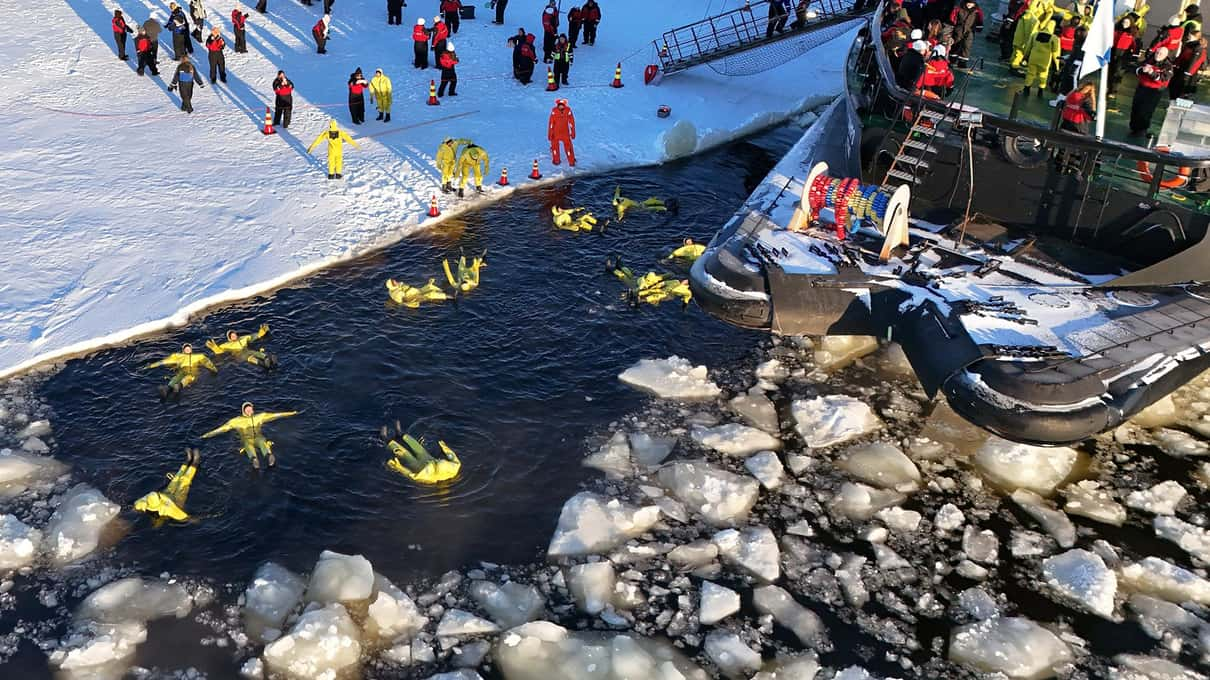
Floating is the part people book for, lying on your back in an orange or yellow survival suit among broken ice off Kemi. It sounds extreme, yet it is mostly a matter of lying still and looking at the sky. Below we cover how it works and who may do it, then what to bring.
What floating means
Once the ship has broken a channel and stopped, guests take turns in thick waterproof survival suits pulled on over their clothes. Reviewers call them lobster suits. In bright orange or yellow, the name fits.
You climb down into the open water the ship has left behind and lie back among the floating chunks. Staff help you in and out, and the suit keeps you on the surface, so nobody has to swim.
An immersion suit is designed to keep a person afloat in cold water, which is why the whole idea works. One Sampo reviewer says they spent about 10 minutes in the water.
Walking on the ice comes first
When conditions allow, guests first step off onto the frozen sea for a walk near the ship, and the floating follows. It is the order most listings and reviews describe.
Neither the walk nor the floating is guaranteed. Each hangs on that day's ice and wind, and early in winter the ice may be too thin to walk on. Our guide to thin ice and windy days covers what still happens then.
Who may float
Height decides who goes in rather than age. Sampo and Arktis set the bar at 140 cm, and the Swedish ship takes children from 125 cm when a parent is in the water with them.
- Floating requires normal health; staff may check and can say no
- The Arktis listing advises against floating in pregnancy
- Icebreaking Company says its cruises do not suit reduced mobility or wheelchair users
- Children below the limit can still join the cruise; ask the operator about walking on the ice
Families weighing these limits will find more in our guide to icebreaker cruises with kids. It also covers how long the day feels for younger children.
Float beside the 1960 Sampo
Floating and a ship tour, plus a walk on the ice when it allows and lunch on the afternoon cruise, from ~$451. Rated 4.7 from 80+ reviews on GetYourGuide.
What to expect in the suit
The suit is thick and stiff, so you move clumsily before you even reach the water. Once you lie back, the ice floes sit around you and the dark hull rises above.
The water stays outside, but the suits are used again and again, so the inside can be damp. Bring a dry change of clothes for afterwards, and wear layers that let you sit and bend inside the suit.
Our guide to dressing for the frozen sea goes through the layers piece by piece. Warm boots with grip matter for the walk, since the suit goes on over whatever you wear.
Photos without your phone
Phones and cameras stay behind when you go into the water. Any shot of you in the channel is taken by the ship's photographer and sold as a paid service.
One Sampo reviewer paid about 25 euros for the photos. Our price guide counts this among the extras to budget, next to meals on the cheaper cruises.
If you travel in a group, take turns. Whoever stays on deck can photograph the others in the channel, then swap places for the next round.
Nerves and the cold
Most people worry about the cold before they go in. Your face is the part left outside the suit, and on a windy day it feels the chill first while the rest of you stays dry.
You do not need to swim, and staff help everyone in and out. If you change your mind at the last moment, you can stay on the ice or on deck and watch the others instead.
After you climb out
Once you are out and the suit is off, the warm lounges are the place to change into dry clothes. Give your fingers a few minutes before you reach for the phone again.
Every cruise on our list hands out a certificate for the floating. On Polar Explorer the captain signs it, hot drinks are part of the fare, and the cafeteria sells food.
On Sampo's afternoon cruise, lunch in the ship's restaurant follows the time on the ice. On Arktis and the morning Sampo cruise, plan a meal at the SnowCastle restaurant or in town afterwards.
Which cruise for floating
All three cruises on our list include floating. Sampo from ~$451 wraps the most around it with a longer cruise and a ship tour, while Arktis from ~$344 is the lower fare if the float is all you want.
Polar Explorer from ~$365 is the choice for families with children between 125 and 140 cm, the only ship where they can float. Its certificate is called the Cruise & Swim Certificate.
Our ship comparison sets the three side by side. It goes deeper into the lounges and the food, plus the review scores.
How the Bothnian Bay ice forms
The Bothnian Bay is the northern end of the Gulf of Bothnia, and its water is brackish, far less salty than the ocean. That lets it freeze over in most winters, and in a cold one the sea ice can grow well over half a meter thick.
An icebreaker rides up onto that ice and cracks it with its weight, leaving the channel of loose floes you float in. How early and how thick the ice forms changes each winter, which our month-by-month guide follows.
If you are based inland, our guide to the day trip from Rovaniemi explains how to reach the coast for a float.